Stories, tips, and guides to where we've been on the bikes so far.
Just click the name of a country (listed alphabetically) to see all related content, or get started with the posts listed below each. More on our overall route here.
When we went: May 2018
Our route: Muriqan – Bahcallek – Vau i Dejes – Koman – [Ferry] – Fierza – Vicidol
When we went: April 2018
Our route: Border post – Neum – Border post

We have found ourselves a home for the next two weeks. A place of our very own, with a balcony and seaside views, in the little Croatian town of Makarska. We can be there in a day, but the place isn't available until the first of April. Four days from now.
And so we bike to the beach. We stock up on four days of food. I fill the jugs strapped to my fork with thirteen liters of water and we carry another ten liters in various bags and bottles attached to our frames and racks. We pedal up a great big hill and come to the secluded spot we'd found on Google's satellite maps a few days earlier.
Our secluded spot is way, way down below.
When we went: August 2017 – September 2017
Our route: Buitepos – Maun – Gweta – Nata – Kazungula

During the 30 days of September, we spent 361 USD on food, 111 USD on accommodations, and 329 USD on everything else. In total, we spent 791 USD, at an average of 26 USD per day (13 USD, per person).

We eat more Flavored Maize Snack the next day and get sick again, but we don't eat as much and so we don't get as sick. We decide this spicy maize snack, good a deal as it may be, is not worth the accompanying fevers. We were planning on riding today, but it's hot and a hundred kilometers to the next town, and we decide just to stay here in Gweta and sit in or around the pool instead.

It begins in the Angolan highlands, where the clouds scrape against the peaks of Mount Moco and the Serra da Chella. Rain falls and rain gathers. It collects itself into creeks and streams. It chases gravity through the mountains. It arrives at a plateau, and here one stream joins another. The waterways meld; they become tributaries. The Cuito. The Cubango. They rush forth. There are more rains and more motion and a great confluence where a river is born. The Angolans call it the Kubango. To the Batswana, it's known as the Okavango. For a thousand kilometers the river carves its way through the earth. It crosses Namibia. It enters the Kalahari.

During the 31 days of August, we spent 320 USD on food, 250 USD on accommodations, and 0 USD on everything else. In total, we spent 570 USD, at an average of 18 USD per day (9 USD, per person).

We leave Gochas, after a lovely night of sushi and good company, with sadness, clean clothes, and a touch of dread. We're not particularly eager to get back on the bikes and cycle ever again, but we suppose it's about time to get moving. Muscles no longer ache, wrists and palms have recovered from the relentless pressure of handlebars, and the hotspots of soreness and chafing are mostly healed. So on the seventh day since entering this town's cozy web of human connections, we depart.
When we went: May 2018
Our route: Kamenichka – Dupnica – Samokov – Kostenets – Plovdiv – Lyubimets

We don't even want to go to Serbia. But here we are, enveloped by a dozen friendly Kosovars, deciding if the border officials over in Serbia will be kind enough to let us in.
We want to go to Macedonia. That is the plan. But this border, the one to Macedonia, the one right over this hill, is closed. The next best option, the way in via Serbia, is not closed. But it's closed to us because we entered Kosovo via Albania, and not via Serbia like the Serbian government insists. We are stuck in the thick agar of bureaucratic purgatory.
It is dark, and thus one thing is certain. Even if we can find a way out of eastern Kosovo, it will not be tonight.
When we went: March 2018 – April 2018
Our route: Jelovice – Rijeka – Prizna – Pag – Zadar – Split – Gruda
We have found ourselves a home for the next two weeks. A place of our very own, with a balcony and seaside views, in the little Croatian town of Makarska. We can be there in a day, but the place isn't available until the first of April. Four days from now.
And so we bike to the beach. We stock up on four days of food. I fill the jugs strapped to my fork with thirteen liters of water and we carry another ten liters in various bags and bottles attached to our frames and racks. We pedal up a great big hill and come to the secluded spot we'd found on Google's satellite maps a few days earlier.
Our secluded spot is way, way down below.

Snow. Lots of it. Everywhere. It is twilight and we are many hundred meters above sea level and the ground all around us is blanketed in a thick wet mass of ice and slush and powder. It is dark and we are cold.
We want to camp but there is nowhere to camp. Nowhere suitable for a picky pair of campers like us, anyway. I suppose we can camp in the snow. I suppose that's something people do. But our tent is thin and technically sold as a "three-season" tent. Nowhere does it list which three seasons it covers, but my money's on all the ones that aren't winter. Because of the snow. Because camping in the snow is nowhere near as fun and enjoyable and comfortable as camping in the not-snow.
When we went: January 2018 – February 2018
Our route: Banyuls-sur-Mer – Leucate – Narbonne – Montpellier – Marseille – Cannes – Menton

So, Lauren's in the hospital.
It's a big, imposing hospital in the center of Marseille. This is, apparently, the only place certain to have the heavy-duty machinery required to drill through the blockages of hardened wax that have lodged themselves in each of her ear canals. Lauren has spent the past several days stoically managing the discomfort and difficulty hearing, and today is the day she gets her sense of sound back.
I, meanwhile, am playing the role of concerned and attentive partner quite well. I am several kilometers away on the Marseille waterfront rifling through items in the first Patagonia shop I've seen since leaving DC. I am like a kid in a candy store, oohing at the new line of backpacks and aahing at the latest edition of full-zip jackets.

Lauren's ears are blocked. Severely so. You might say deafeningly so. Lauren's in pain, and she can't really hear, and not being able to hear on a bicycle isn't just unenjoyable, but dangerous.
We stop in Arles, a sizable town on France's Mediterranean coast, and visit an emergency health clinic. We wait for an hour, maybe more, and the doctor calls Lauren into his office. There is an attempt at removal, but it's a failed attempt. He simply doesn't have the tools to handle an ear blockage of this magnitude. This is a big-city sort of job.

We pedal through Catalonia and it is awash in yellow ribbons. Small streamers tied to mailboxes an multi-story tapestries billowing off the side of buildings. Free our political prisoners. In America citizens call for their politicians to be locked up. Here they hang yellow to bring their parliament home.
Because the parliament is, indeed, in exile. Those that weren't arrested and imprisoned for organizing a peaceful referendum fled to Belgium, and will surely be thrown in jail if they return. This isn't a fringe affair in Catalonia; this is the story. We pass through towns with the faces of the jailed painted on walls. Enormous ¡Si! flags (yes, for independence) hang from balconies. These people don't have a parliament. It's been stolen from them. We find ourselves in the Occupied State of Catalonia, and it's a very strange place to be.
When we went: May 2018
Our route: Ormenio — Krios —Kastanies
We don't even want to go to Serbia. But here we are, enveloped by a dozen friendly Kosovars, deciding if the border officials over in Serbia will be kind enough to let us in.
We want to go to Macedonia. That is the plan. But this border, the one to Macedonia, the one right over this hill, is closed. The next best option, the way in via Serbia, is not closed. But it's closed to us because we entered Kosovo via Albania, and not via Serbia like the Serbian government insists. We are stuck in the thick agar of bureaucratic purgatory.
It is dark, and thus one thing is certain. Even if we can find a way out of eastern Kosovo, it will not be tonight.
When we went: July 2016
Our route: Keflavik – Grindavik – Selfoss – Egilsstaðir – Husavik – Borgarnes – Arnarstapi –Borgarnes – Stykkishólmur – Reykjavik – Keflavik
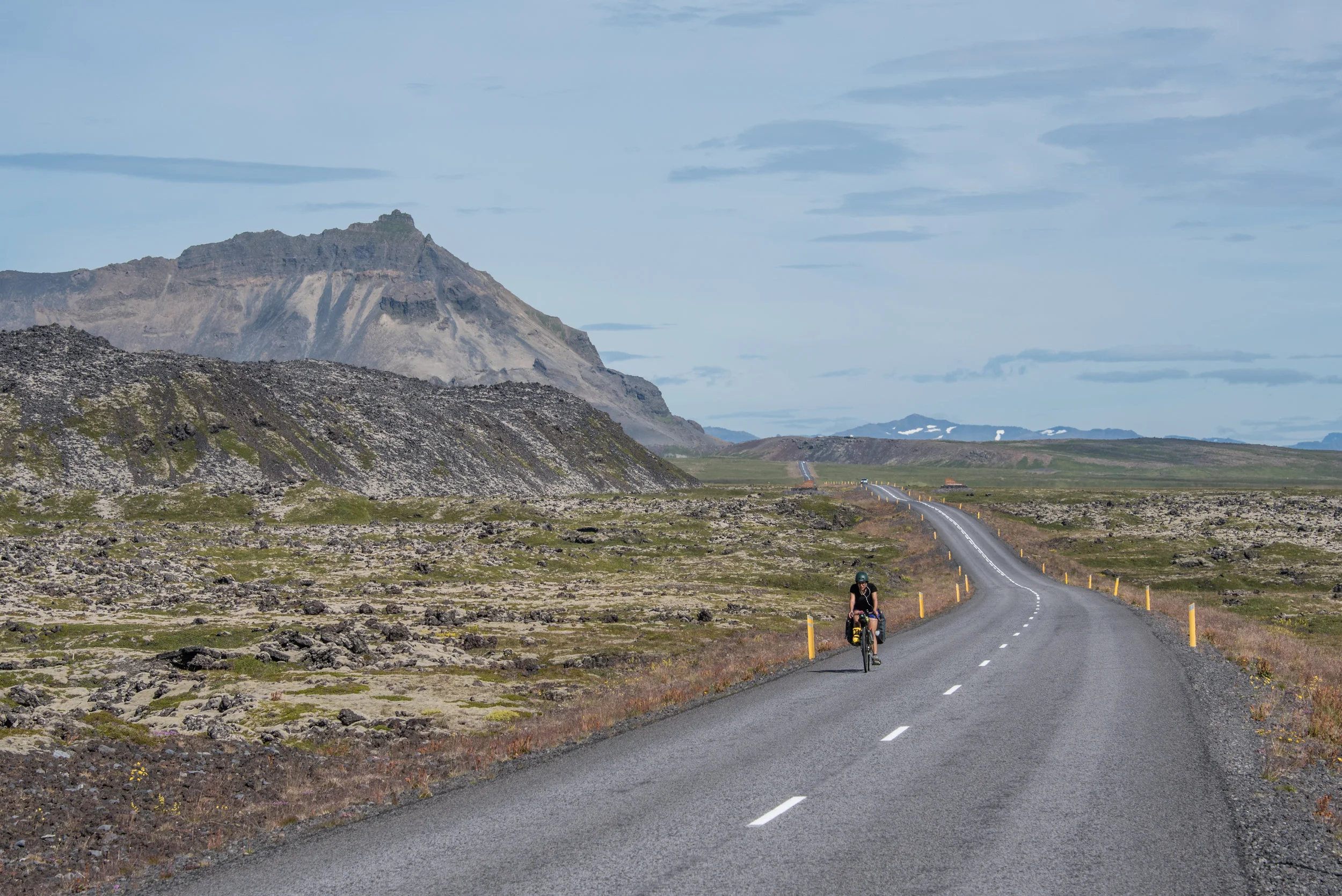
A few months back, I wrote about some things that might be good to know before bike touring around Iceland. Stuff like what weather to expect, where to camp, and how much to budget (oh, and how to get there and which way to travel). Those tips, I hope, captured the logistics of traveling Iceland by bike, but they didn't necessarily capture the experience of doing so. Iceland offers plenty of ups and downs along the way—things that make biking there a pleasure, and things that make it really, really difficult at times. Here are a few of them to consider.

There's this lovely little island in the far north that Lauren and I biked around last summer, that we enjoyed tremendously, and that I was too preoccupied to actually write about while traveling. Nearly six months have elapsed since we returned, and I've sensed those memories beginning to erode. I want to capture what's left of them before they wash out to sea like the bits and pieces of an Icelandic glacier—seemingly frozen, yet shrinking slowly if you know just where to look. Much is already gone, so instead of a full report, consider this a series of disconnected, illustrated vignettes from our time on the road.

Being in Iceland with a bicycle is an excellent recipe for adventure. But actually getting there with said bicycle can be a little more challenging. Disassembling, flying with, putting back together, and escaping the airport with a bicycle is rarely fun, so here are a few tips to make that part of the journey a little less painful.

Kilometer for kilometer, Iceland may just be one of the most diverse, unique, and beautiful places on earth. From lush green farmland to spiky alien lava fields to a mind-boggling abundance of waterfalls, the little island packs a lot in. As such, it's a popular cyclist destination, and it isn't difficult to find lots and lots of really great and really comprehensive bike-specific information before setting out. Here's our take, based on a month of exploration in July of 2016.

If you're planning to circumnavigate Iceland—or cover any distance on the island, really—you'll first need to decide which way to travel. The internet seems to lean in favor of cycling clockwise, from Reykjavik to Akuryri and continuing on, citing prevailing winds. Thankfully, we ignored this advice during our ride, for a few good reasons.
When we went: February 2018 – March 2018
Our route: Ventimiglia – [Train] – Muggia
Snow. Lots of it. Everywhere. It is twilight and we are many hundred meters above sea level and the ground all around us is blanketed in a thick wet mass of ice and slush and powder. It is dark and we are cold.
We want to camp but there is nowhere to camp. Nowhere suitable for a picky pair of campers like us, anyway. I suppose we can camp in the snow. I suppose that's something people do. But our tent is thin and technically sold as a "three-season" tent. Nowhere does it list which three seasons it covers, but my money's on all the ones that aren't winter. Because of the snow. Because camping in the snow is nowhere near as fun and enjoyable and comfortable as camping in the not-snow.
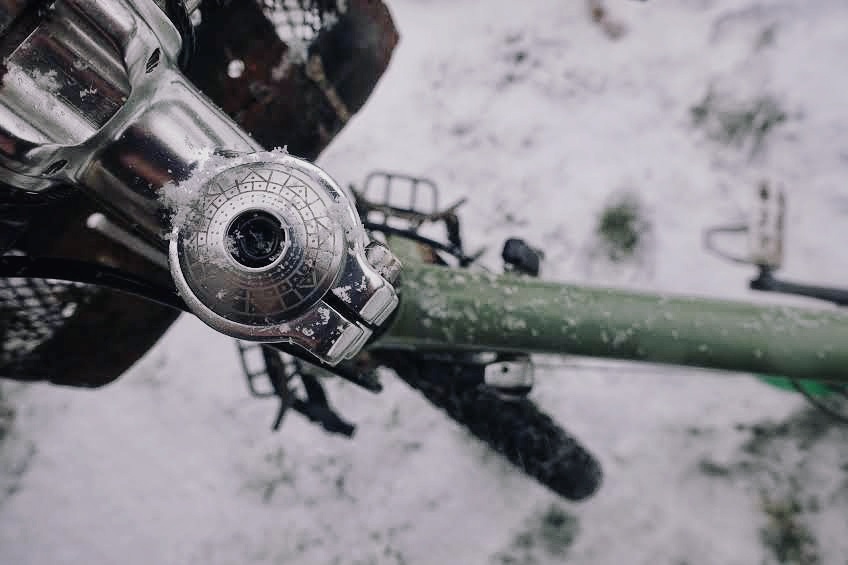
It is colder in Europe than it is at the north pole.
Literally. The temperature at the north pole is above freezing, maybe one or two degrees Centigrade. Which is a little terrifying, because there's a lot of ice up there that's supposed to remain frozen.
Meanwhile, it is well below freezing here in Europe. Some parts of northern Europe are below forty (Celsius, Fahrenheit, doesn't matter; minus forty is minus forty either way). It's not that extreme down in Italy, but it's still pretty damn cold.
So, Lauren's in the hospital.
It's a big, imposing hospital in the center of Marseille. This is, apparently, the only place certain to have the heavy-duty machinery required to drill through the blockages of hardened wax that have lodged themselves in each of her ear canals. Lauren has spent the past several days stoically managing the discomfort and difficulty hearing, and today is the day she gets her sense of sound back.
I, meanwhile, am playing the role of concerned and attentive partner quite well. I am several kilometers away on the Marseille waterfront rifling through items in the first Patagonia shop I've seen since leaving DC. I am like a kid in a candy store, oohing at the new line of backpacks and aahing at the latest edition of full-zip jackets.
When we went: May 2018 — June 2018
Our route: Almaty — Samsi —Kurday — Korday

Dead birds in the gutter. Fistfights in the street. Dust in the air and diesel exhaust in our lungs and white-hot lightning bolts forking down from dark grey stormclouds above. Our departure from Almaty—from our plush hotel room overlooking the park to this—has been an afternoon of the starkest contrasts.
It gets better. We escape Almaty's urban buffer and we enter the steppe. The traffic goes from horrendous to congested to actually quite manageable; the landscape from industrial wasteland to decent to rather pretty rolling hills. We can breathe again.

Cardboard. Scissors. Foam. Lots and lots of packing tape. Nuts and bolts and grease and grime. Papercuts and dirty fingernails. Two boxes. Two bicycles. One taxi. Several bridges and one long highway. One big airport with two security checkpoints. Two passengers, two tickets. One plane. Final-calls and jet engines and seats in the upright position. Eyes out the window. Minarets in the distance, minarets getting smaller, minarets disappearing beneath the clouds. Ten thousand feet. Twenty thousand feet. Thirty thousand feet.
I rub my tired, bleary eyes and peer out the window into the waking dawn. Kazakhstan.
When we went: May 2018
Our route: Ponoshec – Gjakova – Rahovec – Pozharan –Zheger – Kacanik – Elez Han
We don't even want to go to Serbia. But here we are, enveloped by a dozen friendly Kosovars, deciding if the border officials over in Serbia will be kind enough to let us in.
We want to go to Macedonia. That is the plan. But this border, the one to Macedonia, the one right over this hill, is closed. The next best option, the way in via Serbia, is not closed. But it's closed to us because we entered Kosovo via Albania, and not via Serbia like the Serbian government insists. We are stuck in the thick agar of bureaucratic purgatory.
It is dark, and thus one thing is certain. Even if we can find a way out of eastern Kosovo, it will not be tonight.

Nine months. The last time we'd seen Lauren's parents was nine months ago—ten, almost—at the departures terminal of LAX. After a tearful goodbye those last days of June, we'd taken a flight back to Washington, said our farewells to some more loved ones, and packed a few final things. And then we'd flown to Africa.
Summer became autumn and autumn became winter. Winter became spring. We kept in touch, of course. Traveling the world right now, in 2018, is in most ways easier than ever before. For all the ills of modern technology, it can do some incredible things. Phone calls, in real time, from a remote tent in the Tanzanian plains to Bob and V in the outskirts of Los Angeles. Video calls from a roadside wifi spot. Communication, cheaply and easily and rather intimately.
But pixels can only go so far. Nine months is a long time. And so weeks ago, back in Muggia actually, Lauren's parents had agreed to join us in Montenegro at the end of April. And now it is the end of April. And now they're here, looking lovely and three-dimensional and with far fewer beige pixelated boxes affixed to their faces than WhatsApp's low-res videochat display would have us believe.
When we went: Coming soon
Our route: Coming soon

Pearl-white snow and a torrent of hail and then dark.
We enter the tunnel.
I feel it first in my lungs. A tightening, like air being sucked out of a paper bag. Like my airways are filling with something they shouldn't be. Something thick. Like I need a certain amount of oxygen to live and this just isn't enough oxygen to live.
Dead birds in the gutter. Fistfights in the street. Dust in the air and diesel exhaust in our lungs and white-hot lightning bolts forking down from dark grey stormclouds above. Our departure from Almaty—from our plush hotel room overlooking the park to this—has been an afternoon of the starkest contrasts.
It gets better. We escape Almaty's urban buffer and we enter the steppe. The traffic goes from horrendous to congested to actually quite manageable; the landscape from industrial wasteland to decent to rather pretty rolling hills. We can breathe again.
When we went: May 2018
Our route: Skopje – Kumanovo – Stratsin – Uzem
We don't even want to go to Serbia. But here we are, enveloped by a dozen friendly Kosovars, deciding if the border officials over in Serbia will be kind enough to let us in.
We want to go to Macedonia. That is the plan. But this border, the one to Macedonia, the one right over this hill, is closed. The next best option, the way in via Serbia, is not closed. But it's closed to us because we entered Kosovo via Albania, and not via Serbia like the Serbian government insists. We are stuck in the thick agar of bureaucratic purgatory.
It is dark, and thus one thing is certain. Even if we can find a way out of eastern Kosovo, it will not be tonight.
When we went: October 2017 – November 2017
Our route: Mchinji – Lilongwe – Senga Bay – Monkey Bay – Nkopola – Cape Maclear – Monkey Bay – Likoma – Nkhata Bay – Mzuzu – Livingstonia – Songwe
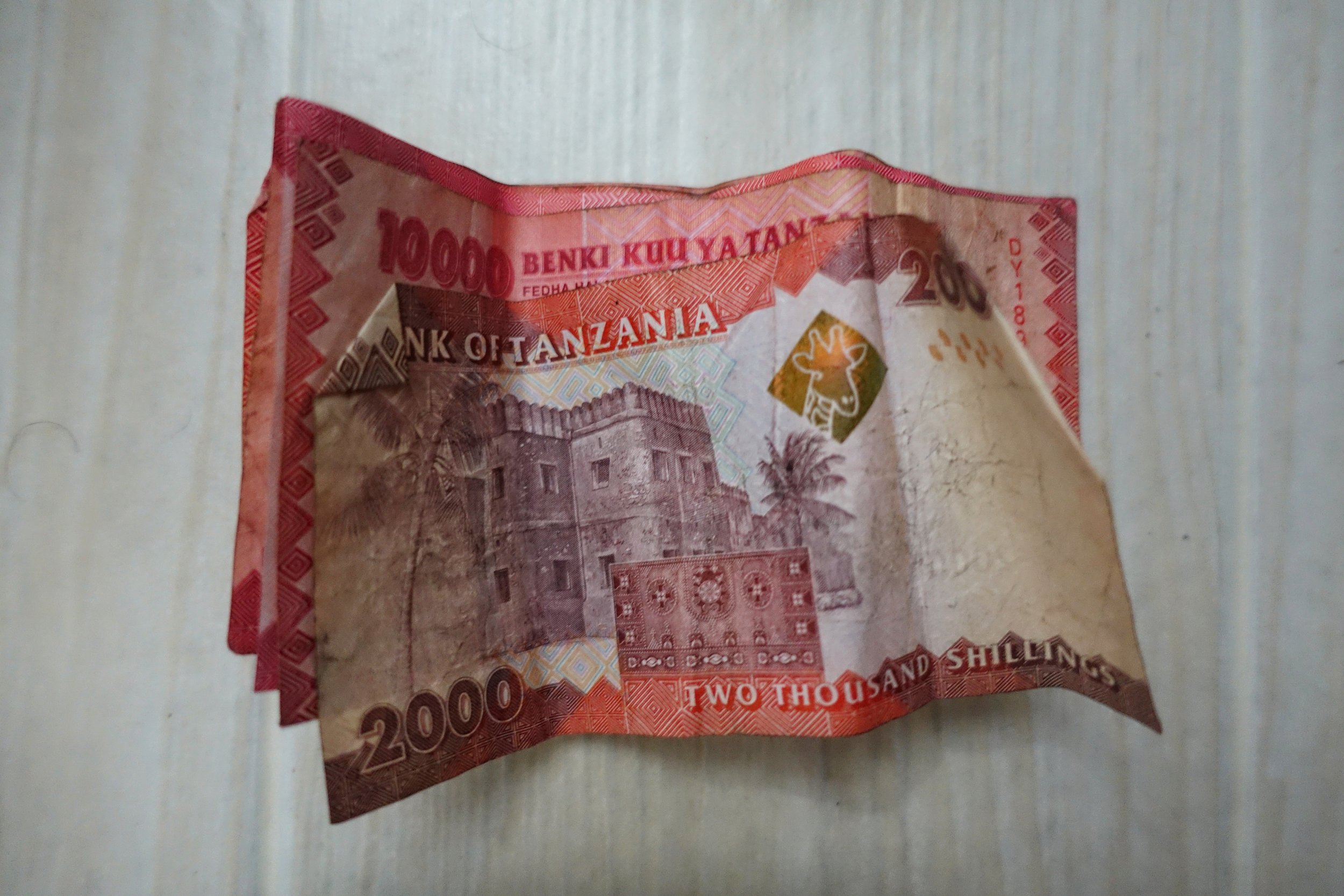
During the 30 days of November, we spent 364 USD on food, 136 USD on lodging, and 284 USD on everything else (including 200 USD for our Tanzanian visas). In total, we spent 784 USD, at an average of 26 USD per day (13 USD, per person).

During the 31 days of October, we spent 318 USD on food, 91 USD on accommodations, and 258 USD on everything else. In total, we spent 667 USD, at an average of 22 USD per day (11 USD, per person).

The sunrise is beautiful as Lauren, Quentin, and I sit silently in a small dinghy cutting across the calm waters of Nkhata Bay. The first rays of morning light break over the trees, and the sky is all pink and cerulean and thin, wispy clouds. Under different circumstances, this would be a lovely way to begin a day.

It is noon and I am in the cramped bathroom of a dusty petrol station vomiting my insides into the sink. I haven't eaten very much in days, and so fortunately there is little volume to the upchuck. It's mostly bile, burning at my throat, stinging my eyes. I steady my shivering body against the wall and examine my grey complexion in the cracked mirror. This was a uniquely terrible idea. One should not be riding a bike when one is recovering from malaria.

I spend Friday night shaking and sweating and unable to regulate my body's temperature. The air conditioner is on full blast and I'm mildly aware that the room cannot be more than 20C, but it feels like a sauna. I feel like I might vomit but do not vomit. A few times during the night, I rise to use the toilet, and walking to the bathroom next door feels like a Herculean effort.
I toss and turn and feel an ache in my bones. I think about how we sometimes say that we can feel aching in our bones to express how sore we are, but like, right now it really feels like the marrow inside me is boiling. It's not a dull, too-tired sort of ache, but the active, acute, it-hurts-all-over kind.

Saying goodbye to the people we meet is always hard. We're a long way from home. We're going a long way from wherever we are. And it's pretty certain that for the majority of the people we cross paths with, we won't see them ever again. Saying goodbye to our new friends in Lusaka was especially hard. We'd grown attached to our hosts during our five days there. Though we'd all promised to keep in touch and see each other someday, someday is a very vague, flighty notion.
So it was a delightful surprise to hear, during our final few days in Zambia, that Sarah and Cassidy were taking the kids for a holiday on Lake Malawi in a few weeks' time. They'd be renting a beach house with Libby and Brian (our terrific hosts in Lilongwe), and invited us along if it was on our way.
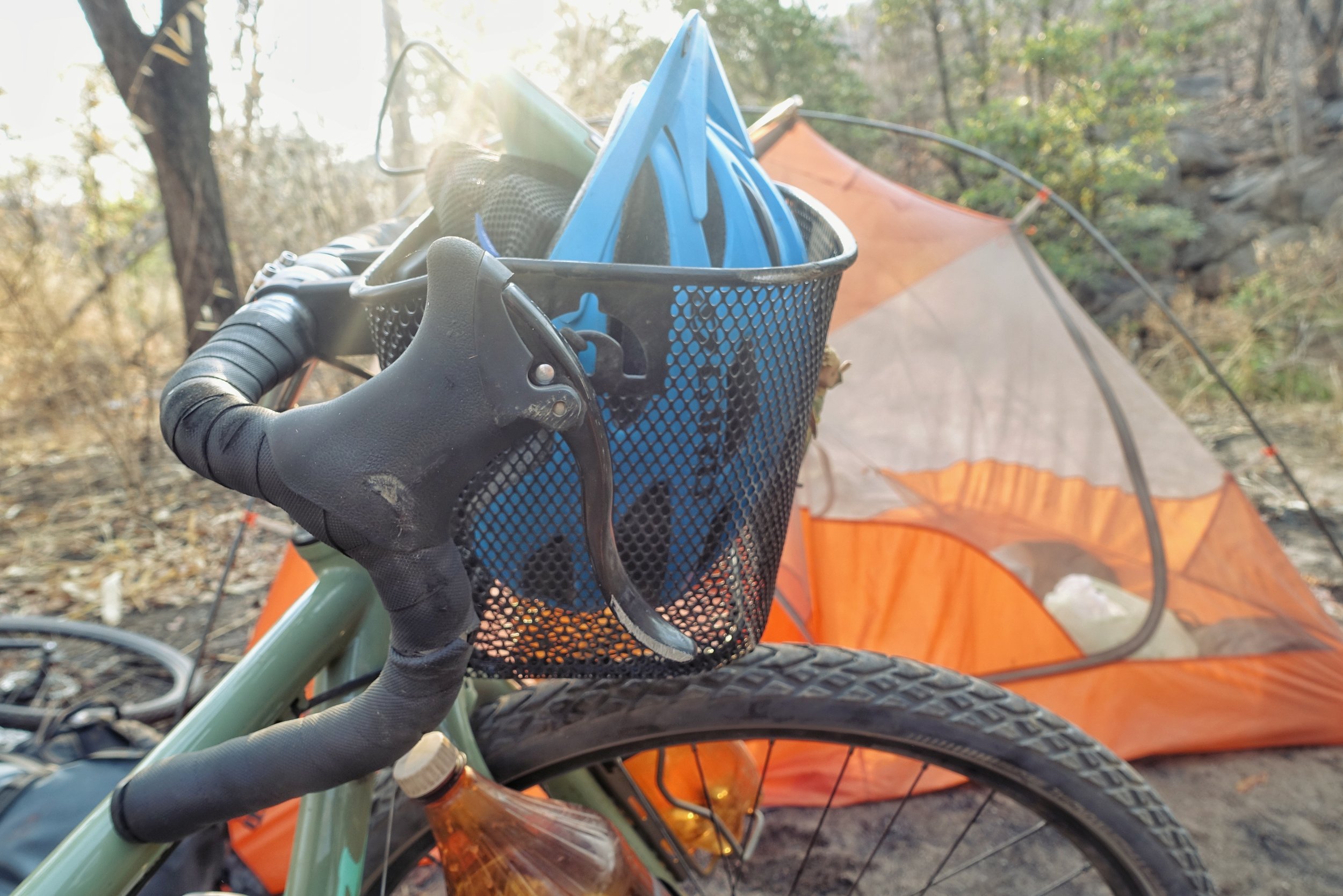
The cement is hot. Too hot. I am lying on my right side at the bottom of a long hill with a burning sensation running through my skin. I feel pain and dread and anger at myself for being so careless. Slowly, I rise to my feet.
My bike is a few meters behind me. One of the panniers has flown off the rack and landed next to my body. I look down. Its vinyl exterior is coated in a brown ooze that looks not too dissimilar from something that might leak out of a stomach. I lift my shirt to check the state of my organs. They feel intact. I realize that this murky goop is not coming from inside me, but inside my pannier. A kilogram of chunky peanut butter I'd been carrying has exploded, its contents leaking out onto the dusty concrete.
When we went: February 2018
Our route: Les Salines – La Rousse
So, Lauren's in the hospital.
It's a big, imposing hospital in the center of Marseille. This is, apparently, the only place certain to have the heavy-duty machinery required to drill through the blockages of hardened wax that have lodged themselves in each of her ear canals. Lauren has spent the past several days stoically managing the discomfort and difficulty hearing, and today is the day she gets her sense of sound back.
I, meanwhile, am playing the role of concerned and attentive partner quite well. I am several kilometers away on the Marseille waterfront rifling through items in the first Patagonia shop I've seen since leaving DC. I am like a kid in a candy store, oohing at the new line of backpacks and aahing at the latest edition of full-zip jackets.
When we went: April 2018 – May 2018
Our route: Herceg Novi – Kamenari – Muo – Budva – Dobra Voda – Krute – Sukobin
Nine months. The last time we'd seen Lauren's parents was nine months ago—ten, almost—at the departures terminal of LAX. After a tearful goodbye those last days of June, we'd taken a flight back to Washington, said our farewells to some more loved ones, and packed a few final things. And then we'd flown to Africa.
Summer became autumn and autumn became winter. Winter became spring. We kept in touch, of course. Traveling the world right now, in 2018, is in most ways easier than ever before. For all the ills of modern technology, it can do some incredible things. Phone calls, in real time, from a remote tent in the Tanzanian plains to Bob and V in the outskirts of Los Angeles. Video calls from a roadside wifi spot. Communication, cheaply and easily and rather intimately.
But pixels can only go so far. Nine months is a long time. And so weeks ago, back in Muggia actually, Lauren's parents had agreed to join us in Montenegro at the end of April. And now it is the end of April. And now they're here, looking lovely and three-dimensional and with far fewer beige pixelated boxes affixed to their faces than WhatsApp's low-res videochat display would have us believe.
We have found ourselves a home for the next two weeks. A place of our very own, with a balcony and seaside views, in the little Croatian town of Makarska. We can be there in a day, but the place isn't available until the first of April. Four days from now.
And so we bike to the beach. We stock up on four days of food. I fill the jugs strapped to my fork with thirteen liters of water and we carry another ten liters in various bags and bottles attached to our frames and racks. We pedal up a great big hill and come to the secluded spot we'd found on Google's satellite maps a few days earlier.
Our secluded spot is way, way down below.
When we went: (1) February 2016 & (2) December 2017
Our route: (1) Marrakesh – Tizi n'Test – Tafroute – Tiznit – Sidi Ifni – Essaouria – Marrakesh &
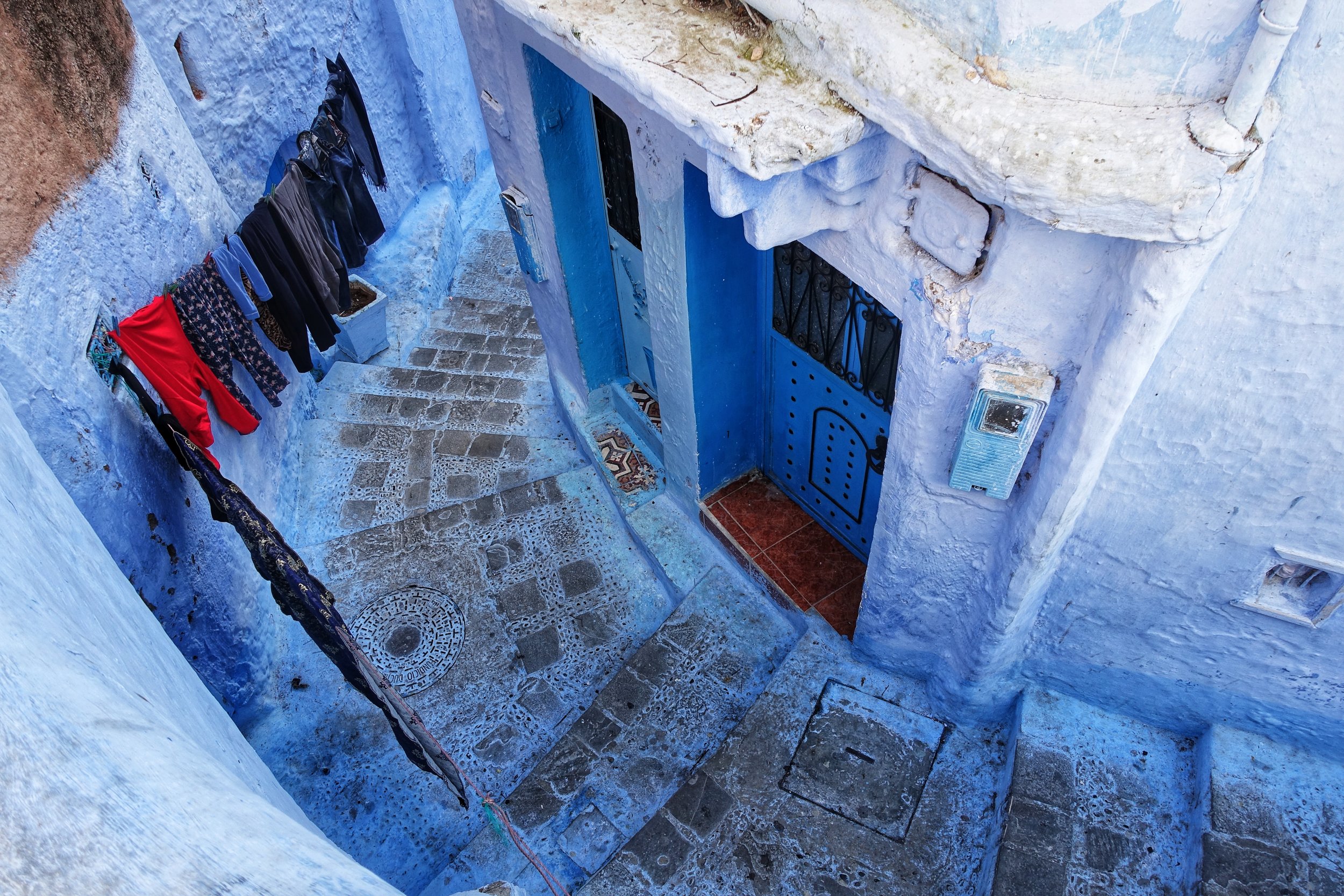
(2) Casablanca – Rabat – Meknes – Fes – Chefchaouen – Tetouan – Ceuta (Spain)

You watch the news and you read the papers and you're led to believe that the world is a big, scary place. People, the narrative goes, are not to be trusted. People are bad. People are evil. People are axe murderers and monsters and worse.
I don't buy it. Evil is a make-believe concept we've invented to deal with the complexities of fellow humans holding values and beliefs and perspectives different than our own—it's easier to dismiss an opinion as abhorrent than strive to understand it. Badness exists, sure, but even that's quite rare. By and large, humans are kind. Self-interested sometimes, myopic sometimes, but kind. Generous and wonderful and kind. No greater revelation has come from our journey than this.

It is raining. We are damp. It is pouring. We are soaked. It is morning. The morning after the evening in which we were kindly given a house to sleep in when all we were looking for was a little bit of grass. We slept well, we packed our things, and we set off for Meknes. And then came the rain. Lots of rain.
And now we are wet. Very wet.
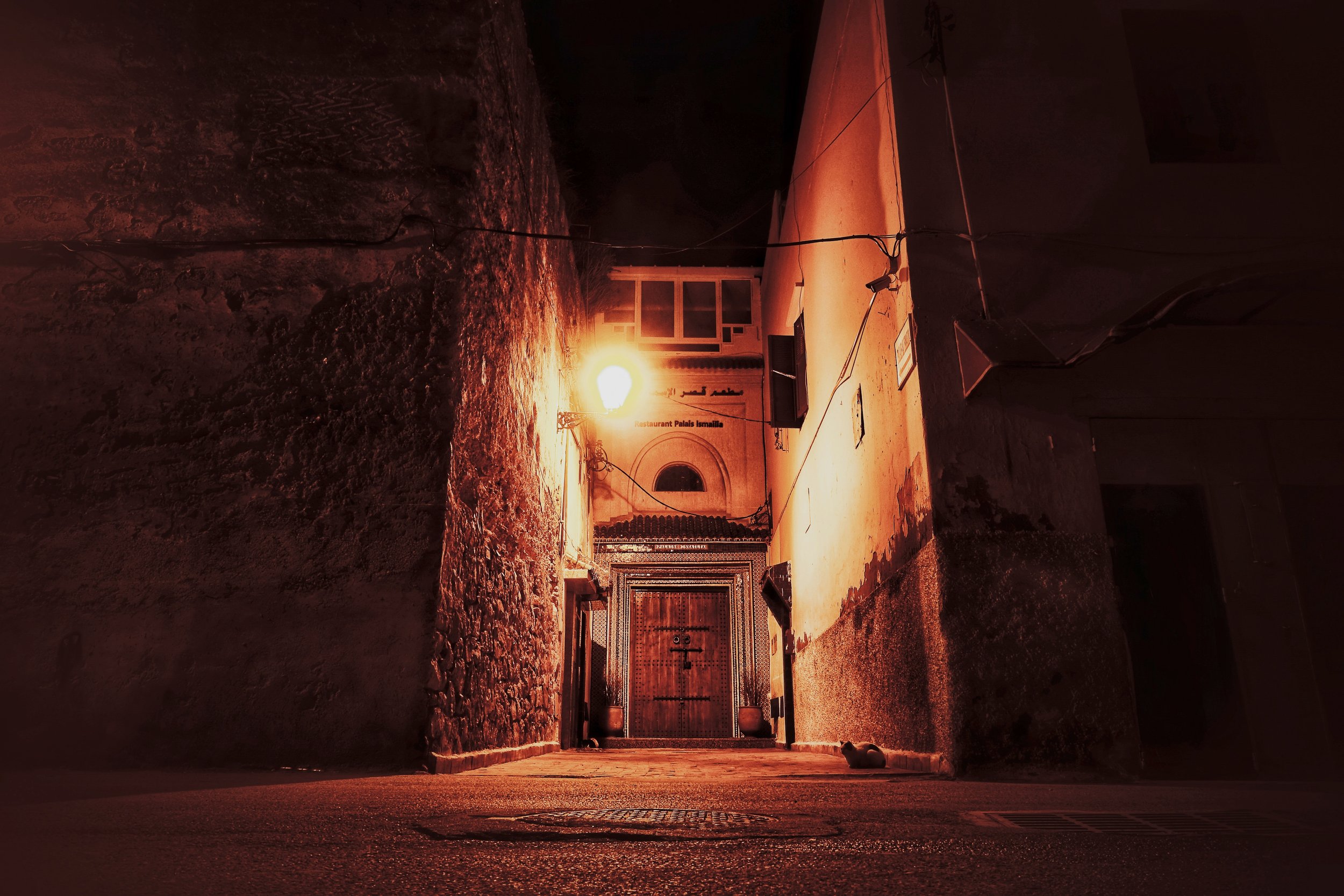
Of all the gin joints in all the world, we find ourselves here. Casablanca.
Approximately. We're not really in Casablanca, but the Casablanca Mohammed V International Airport, which is about thirty kilometers south and east from Casablanca proper in a dusty little place called Nouaceur.
We won't be going to Casablanca. For all its Humphrey Bogart-inspired old-timey allure, modern Casablanca is roundly summarized as an expensive, gritty, industrial port town with little in the way of pleasant ambience or Moroccan culture. There are nicer gin joints to be found.

During the 31 days of December, we spent 336 USD on food, 108 USD on lodging, and 304 USD on everything else. In total, we spent 748 USD, at an average of 24 USD per day (12 USD, per person).

Before starting this site, I wrote on and off elsewhere about my various travels. Most of it's pretty useless and doesn't really belong here, but my bike trip through Morocco in February 2016 felt pretty relevant, so here it is in it's unabridged entirety: a rambling travelogue of a month spent solo cycling in northern Africa.
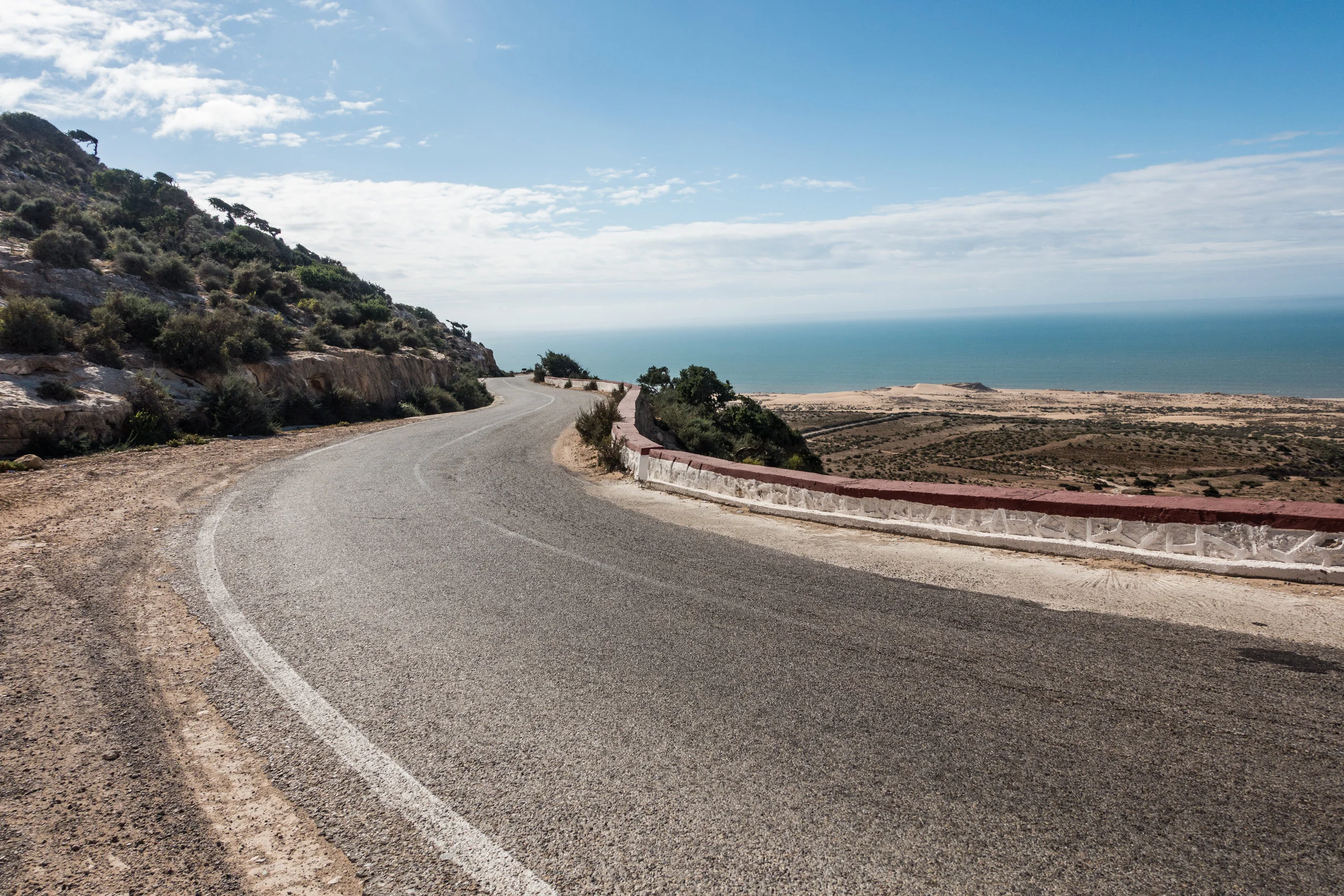
In February 2016, I headed to Morocco for my very first cycling trip. Starting in Marrakesh and heading south over the Atlas Mountains via the Tizi n'Test pass, I traveled to Tafrout and onwards to the southern Moroccan coast—requiring two climbs over the Anti-Atlas range—before reaching Sidi Ifni, turning north to Essaouria, and returning to Marrakesh at the end of the month. It was a challenging, rewarding, amazing journey; here are a few things I learned en route.
When we went: July 2017 – August 2017
Our route: Velloorsdrif –Karasburg – Koes – Gochas – Gobabis – Buitepos
During the 31 days of August, we spent 320 USD on food, 250 USD on accommodations, and 0 USD on everything else. In total, we spent 570 USD, at an average of 18 USD per day (9 USD, per person).
We leave Gochas, after a lovely night of sushi and good company, with sadness, clean clothes, and a touch of dread. We're not particularly eager to get back on the bikes and cycle ever again, but we suppose it's about time to get moving. Muscles no longer ache, wrists and palms have recovered from the relentless pressure of handlebars, and the hotspots of soreness and chafing are mostly healed. So on the seventh day since entering this town's cozy web of human connections, we depart.

We've now been on the road a little longer than a month. As far as months go, it's been a tough one. Since leaving our wonderful hosts in Cape Town, we've been challenged physically, mentally, and emotionally. We've put ourselves through more isolation, desolation, rough roads, hard days, arduous climbs and stubborn headwinds than we'd bargained for. At times we've been bored, frustrated, and hopeless. But here in the small outposts of the Kalahari, we've forged human connections that have warmed us to the bone.
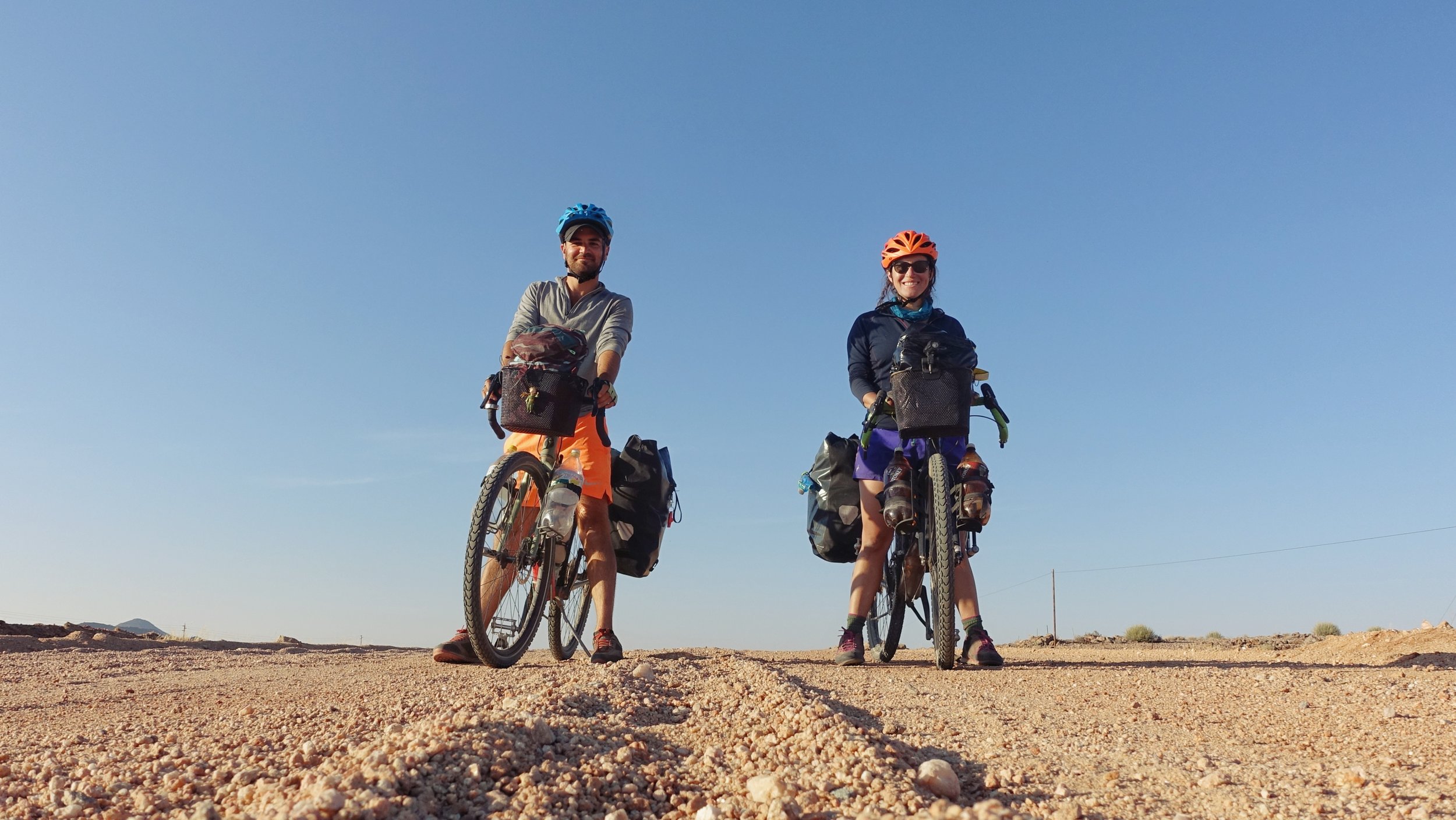
Area where there is nothing. This is what Namibia means in Khoekhoe, the language of the Nama people. It is a large place, Namibia. It is twice the size of California, a twelfth the size of the entire United States. And yet, life here is sparse. California holds some forty million people; Namibia is home to just two million. With fewer than three persons per square kilometer, it's the fifth least densely populated country on Earth.
When we went: March 2018
Our route: Kolomban – Dekani – Podgorje
Snow. Lots of it. Everywhere. It is twilight and we are many hundred meters above sea level and the ground all around us is blanketed in a thick wet mass of ice and slush and powder. It is dark and we are cold.
We want to camp but there is nowhere to camp. Nowhere suitable for a picky pair of campers like us, anyway. I suppose we can camp in the snow. I suppose that's something people do. But our tent is thin and technically sold as a "three-season" tent. Nowhere does it list which three seasons it covers, but my money's on all the ones that aren't winter. Because of the snow. Because camping in the snow is nowhere near as fun and enjoyable and comfortable as camping in the not-snow.
When we went: July 2017
Our route: Muizenberg – Cape Town – Elaansbaii – Clanwilliam – Loeriesfontein – Onseepkans

From July 8 (when we began our trip) until the end of the month, we spent 2,301 ZAR on food, 2,959 ZAR on accommodations, and 120 ZAR on everything else. In total, we spent 5,380 ZAR (399 USD) in 24 days, at an average of 224 ZAR per day (112 ZAR, or 8 USD, per person).

By the time we drag ourselves from our cozy room and into the quiet streets of Loeriesfontein, it's well past noon. We're outside the Spar, the local grocery, filling our already-overstuffed panniers with over five days of food. The bikes sway under the weight of our rations. Accompanying the spaghetti and peanut butter and noodles and chips is water. Lots of it. Over sixteen pounds of water is strapped to my rear rack in a pair of bulging plastic bladders. Twenty-five additional pounds' worth are carried in a collection of eight bottles split between the two of us.

The days northward begin to blend together. The roads and the hills and the rest stops begin weaving into a tapestry of sights and smells, a patchwork of rough and smooth textures. There are challenging climbs and there are thrilling descents. There are tailwinds and many headwinds. There are many honks and waves of encouragement, plenty of quick encounters packing up outside the grocery.

I've said before that Cape Town is a terrible place for a bicycle. We do our best to head north, but our best doesn't get us very far. The oceanside promenade from Sea Point to the Waterfront disintegrates just east of the main tourist drag, and the first moments of our worldwide bike tour are interrupted by a large set of stairs calling it all to a halt.
It's daybreak, wherever we are.
Above the clouds, above the earth, above Africa. Down below lie vast open spaces. They're punctuated by thin meandering lines of tar or dirt or single-track. Up here there are no borders, few landmarks. I look out the window and gaze down at our coming months.
When we went: December 2017 – January 2017
Our route: Ceuta – Algeciras – Ronda – Puente Genil – Jaen – Valencia – Barcelona – Portbou
We pedal through Catalonia and it is awash in yellow ribbons. Small streamers tied to mailboxes an multi-story tapestries billowing off the side of buildings. Free our political prisoners. In America citizens call for their politicians to be locked up. Here they hang yellow to bring their parliament home.
Because the parliament is, indeed, in exile. Those that weren't arrested and imprisoned for organizing a peaceful referendum fled to Belgium, and will surely be thrown in jail if they return. This isn't a fringe affair in Catalonia; this is the story. We pass through towns with the faces of the jailed painted on walls. Enormous ¡Si! flags (yes, for independence) hang from balconies. These people don't have a parliament. It's been stolen from them. We find ourselves in the Occupied State of Catalonia, and it's a very strange place to be.

Instagram isn't good for very much. By and large it's a smarmy mosh pit of self-promotion and self-aggrandizement, and on its best days it's still not a very good use of time. But occasionally a little good can from it.
Yesterday I posted a photo of Lauren and our bikes in Valencia's main park. Someone following me on Instagram sent a message. You guys are in Valencia? I'm just a little ways up the coast. Will you be passing by?

It is snowing. But not the good, pretty kind.
We are soaked to the bone. We are trembling. We cannot feel our fingers.
Lauren's tire is flat. Her wheel is not turning. Between the problem of the snow and the problem of the numb fingers, we cannot fix it.
We are on an empty mountain road. It will be dark in a few hours. And then temperatures, already freezing, will plummet.
We have tried to bail out. We have thrown in the towel. Bus, train, anything. But no one is picking up our towel. It is a holiday. The third in three weeks. We got lucky for the first two. Christmas. New Year's. It seems our luck has run out. It is Three Kings' Day, and we are all alone.

We leave olive country. We ride through a strange, bald landscape of rolling hills and few trees. We use Google Maps for our route planning today, which is always something of a gamble. It takes us across goat trails and private access roads and train tracks and dead ends. It is unpredictable yet fun.
Ordinarily we wouldn't have time for Google Maps and its unreliable detours. But we don't have very far to go today. Just forty or fifty kilometers to Linares.

Yesterday Lauren woke up, in an abandoned building outside of Ronda, with some swelling in her eye.
Today Lauren wakes up, in an abandoned building outside of Campillos, with some more swelling in her eye. Inflammation, redness, mucus. Lots of mucus.
Lauren has pinkeye.

Lauren is asking a pair of police officers nearby if they know of any cheap hostels when Pablo approaches me. Our bikes and deer-in-headlights gaze have given away that we are not from here. Pablo asks where we're from. Are we lost?
A little. I tell him our sob story: from America, long bike trip, just arrived, looking for somewhere to camp, having great difficulty. He's friendly but doesn't know of any spots in the city. He hasn't lived here for a while. He's from Algeciras, and his whole family is still here, but he works up in Belgium. He's home for the holidays.
Let me go ask my brother, he says. In the meantime, come join the party. Can I get you some hot cocoa? Pastries? Here, take these.

We have been in Spain about ten seconds.
And I am being run over. Intentionally. In slow motion.
I am banging on his hood, his windshield, his mirror. Lauren is screaming for him to please stop from across the street. I am shouting, too. I am shouting and flailing my right arm and smacking his car with my left one and also trying to heave my heavy loaded bicycle from between these two vehicles, partially submerged beneath one of them. All the while, he watches me blankly.
You watch the news and you read the papers and you're led to believe that the world is a big, scary place. People, the narrative goes, are not to be trusted. People are bad. People are evil. People are axe murderers and monsters and worse.
I don't buy it. Evil is a make-believe concept we've invented to deal with the complexities of fellow humans holding values and beliefs and perspectives different than our own—it's easier to dismiss an opinion as abhorrent than strive to understand it. Badness exists, sure, but even that's quite rare. By and large, humans are kind. Self-interested sometimes, myopic sometimes, but kind. Generous and wonderful and kind. No greater revelation has come from our journey than this.
During the 31 days of December, we spent 336 USD on food, 108 USD on lodging, and 304 USD on everything else. In total, we spent 748 USD, at an average of 24 USD per day (12 USD, per person).
When we went: Coming soon
Our route: Coming soon
When we went: November 2017
Our route: Songwe – Mbeya – Makambako – Iringa – Mikumi – Dar es Salaam – Zanzibar
During the 31 days of December, we spent 336 USD on food, 108 USD on lodging, and 304 USD on everything else. In total, we spent 748 USD, at an average of 24 USD per day (12 USD, per person).
During the 30 days of November, we spent 364 USD on food, 136 USD on lodging, and 284 USD on everything else (including 200 USD for our Tanzanian visas). In total, we spent 784 USD, at an average of 26 USD per day (13 USD, per person).

We learn the story of the TanZam Highway slowly, day by day. Clues present themselves to the observant traveler. Green markings sprayed hastily onto houses. Red Xs blotted onto each and every road sign. There's the Chinese face looking on from beneath a face mask as Tanzanian men hack away at the blackened earth. There's a careful consideration of the name, TanZam, and an answer right on the map, if one knows where to look.
All roads have purpose, and most purpose is conquest. Building a road consumes more than paint and bitumen.

Hop on a plane or train or bus, or even into the seat of a car, and you are transported from one distinct place to another distinct place. One of the lovelier aspects of bike touring, then, is exploring these subtle changes in landscape and culture on a continuum. Cycling is (typically) fast enough to not get (too) bored, but generally slow enough to recognize and register these in-between places. It's a wonder to wake each up morning in a slightly different place, to look back a week in time and space and find that things weren't so different, but they weren't just the same, either.
When we went: May 2018
Our route: Pazarkule Karagac — Edirne — Havsa —Yenibedir — Tekirdag — Istanbul
We don't even want to go to Serbia. But here we are, enveloped by a dozen friendly Kosovars, deciding if the border officials over in Serbia will be kind enough to let us in.
We want to go to Macedonia. That is the plan. But this border, the one to Macedonia, the one right over this hill, is closed. The next best option, the way in via Serbia, is not closed. But it's closed to us because we entered Kosovo via Albania, and not via Serbia like the Serbian government insists. We are stuck in the thick agar of bureaucratic purgatory.
It is dark, and thus one thing is certain. Even if we can find a way out of eastern Kosovo, it will not be tonight.
When we went: Coming soon
Our route: Coming soon
When we went: September 2017 – October 2017
Our route: Kazungula – Livingstone – Lusaka – Chipata
During the 31 days of October, we spent 318 USD on food, 91 USD on accommodations, and 258 USD on everything else. In total, we spent 667 USD, at an average of 22 USD per day (11 USD, per person).
During the 30 days of September, we spent 361 USD on food, 111 USD on accommodations, and 329 USD on everything else. In total, we spent 791 USD, at an average of 26 USD per day (13 USD, per person).
The cement is hot. Too hot. I am lying on my right side at the bottom of a long hill with a burning sensation running through my skin. I feel pain and dread and anger at myself for being so careless. Slowly, I rise to my feet.
My bike is a few meters behind me. One of the panniers has flown off the rack and landed next to my body. I look down. Its vinyl exterior is coated in a brown ooze that looks not too dissimilar from something that might leak out of a stomach. I lift my shirt to check the state of my organs. They feel intact. I realize that this murky goop is not coming from inside me, but inside my pannier. A kilogram of chunky peanut butter I'd been carrying has exploded, its contents leaking out onto the dusty concrete.

The most we've traveled in a single day since leaving Cape Town has been 114 kilometers. Aided by downhills and the sole run of tailwinds we've had to date, it is one of only a few days we've surpassed the 100-kilometer mark. Our plan for the next five days is to cycle one hundred kilometers, on average, each and every day. This time, we'll be traveling uphill. Into a headwind.
We get started.

There's a tiny dot in the middle of the Zambezi River where the boundaries of four nations come together. It's called a quadripoint, or more precisely the quadripoint, as it's the only place in the world where this happens. For a brief moment, a person floating downs the Zambezi might find their left leg in Zambia, their right leg in Zimbabwe, their left arm in Namibia, and their right arm in Botswana. The moment would be brief partly because the dot is small and the current strong, but also because the river is riddled with crocodiles and someone floating in its waters would lose one of those limbs pretty quickly.
Where we're headed is all very flexible and subject to our whims (and those of visa-issuing bureaucrats). Our journey began in Cape Town in July 2017 and continued through southern and eastern Africa. We flew from Dar es Salaam, Tanzania to Casablanca, Morocco in December, pedaling north and east across Europe. Between January and May 2018, we cycled from southern Spain to Istanbul, Turkey, then (to catch central Asia in a better season), flew to Almaty, Kazakhstan. As of June 2018, we're currently heading west back towards Turkey, planning later to fly to India and pedal southeast Asia. Then, maybe onwards to Oceania, South America, and back home to the United States. The map below is updated with our rough progress every once in a while. Green lines (approximately) mark our cycling route. Grey lines signal where we took planes, trains, buses, ferries, or hitchhiked, and pink lines show where we've cycled on past trips.
Nine months. The last time we'd seen Lauren's parents was nine months ago—ten, almost—at the departures terminal of LAX. After a tearful goodbye those last days of June, we'd taken a flight back to Washington, said our farewells to some more loved ones, and packed a few final things. And then we'd flown to Africa.
Summer became autumn and autumn became winter. Winter became spring. We kept in touch, of course. Traveling the world right now, in 2018, is in most ways easier than ever before. For all the ills of modern technology, it can do some incredible things. Phone calls, in real time, from a remote tent in the Tanzanian plains to Bob and V in the outskirts of Los Angeles. Video calls from a roadside wifi spot. Communication, cheaply and easily and rather intimately.
But pixels can only go so far. Nine months is a long time. And so weeks ago, back in Muggia actually, Lauren's parents had agreed to join us in Montenegro at the end of April. And now it is the end of April. And now they're here, looking lovely and three-dimensional and with far fewer beige pixelated boxes affixed to their faces than WhatsApp's low-res videochat display would have us believe.